
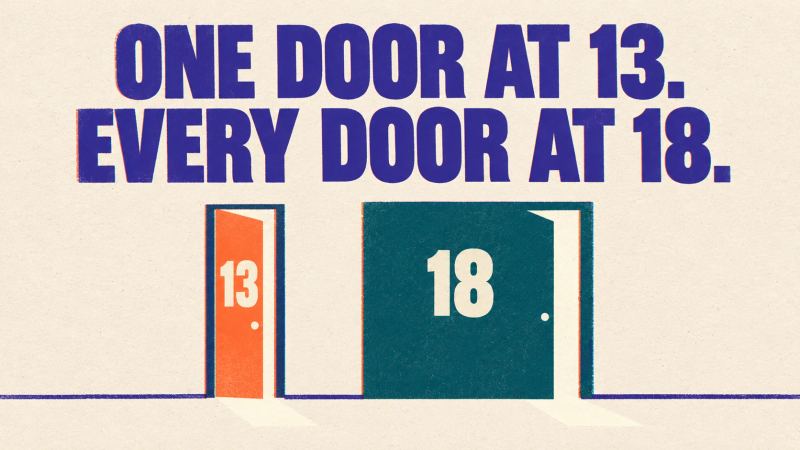
The short answer: age limits by category
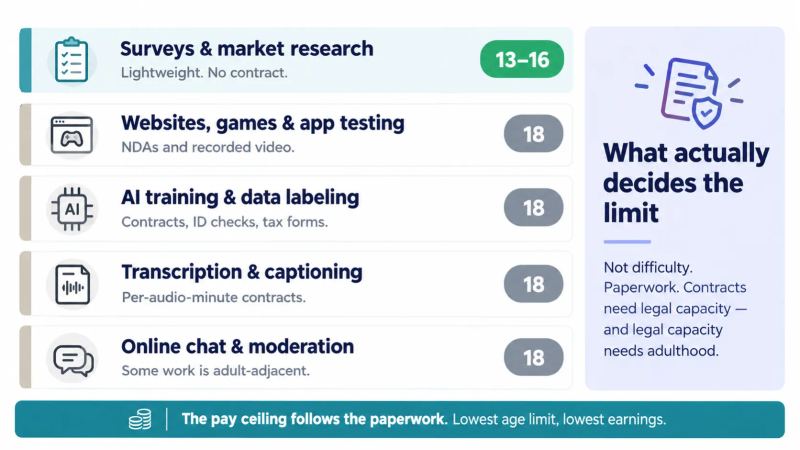
Survey panels are the only category that accepts teenagers. Everything else requires adulthood. That single fact shapes everything a teen can earn online.
| Category | Minimum age | Why |
|---|---|---|
| Surveys & market research | 13–16 on some panels | Lightweight work, no contract needed |
| Websites, games & app testing | 18 | Non-disclosure agreements and recordings |
| AI training & data labeling | 18 | Contracts, ID checks, tax paperwork |
| Transcription & captioning | 18 | Per-audio-minute contracts |
| Online chat & moderation | 18 | Some work is adult-adjacent |
Notice what drives the difference. It isn't difficulty. It's paperwork.
Surveys need a demographic profile and a payout method. That's it. Testing needs a signed NDA and a recorded video of you. AI training needs a contract, identity verification, and a tax form. Transcription needs a billing agreement.
Contracts require legal capacity. Legal capacity requires adulthood. The pay ceiling follows the paperwork — which is why the category with the lowest age limit also has the lowest earnings.
Which platforms actually accept under-18s?
We check the minimum age on every platform we track. So how old do you have to be to take surveys? Here's what the published age floors reveal:
| Minimum age | Platforms that accept it |
|---|---|
| 13 | Swagbucks, Harris Poll Online, SurveySavvy, dscout, CrowdTap, Focus Forward |
| 14 | Marketagent, Rare Patient Voice |
| 15 | Pureprofile |
| 16 | YouGov, LifePoints, Toluna, Branded Surveys |
| 18 | Everything else in our directory |
Those names are the entire map for under-18s — and every one of them is a survey panel.
The notable one is Swagbucks. It accepts members from 13, and it has the lowest cash-out threshold we've found anywhere: gift cards from $3. For a teenager wanting to test whether this whole thing is real, that's the fastest honest answer available.
dscout is worth knowing about too. It appears on both lists — it accepts from 13, and its missions pay 150, with live interviews running 150. For a teenager, that's a dramatically better rate than a survey panel. Expect more screening and a longer wait for a match.
A pattern worth noticing
Every platform that accepts teens is a panel. Not one is a marketplace, a testing platform, or an AI-training outfit.
That's not a coincidence, and it's not arbitrary. Panels collect opinions in bulk and pay small amounts through gift cards or PayPal. There's no contract, no deliverable ownership, and no confidentiality clause. It's the only structure in this industry that works with a minor on the other end.
What changes when you turn 18
Your options open up dramatically overnight. Every platform that requires 18 becomes available at once — and that's where the money is.
Here's the comparison:
| Under 18 | 18 and over | |
|---|---|---|
| Platforms available | A small handful of panels | The whole directory |
| Realistic rate | 2-6/hr | 10-40/hr |
| Typical payout | Gift cards, small PayPal | PayPal, bank transfer |
| Payout minimum | 3-10 | Varies |
The rate jump is the part that matters. Survey panels pay $6 an hour once you account for screen-outs. Usability testing pays about 15 to $40 an hour.
So the teenager earning $300 a month on testing are doing comparable work at comparable effort. The only thing that changed was a birthday.
That's worth knowing before you spend a year grinding surveys. If you're 17, the highest-return thing you can do is prepare — build your profile, learn the think-aloud skill, get comfortable on camera — so you can apply the week you turn 18.
The laws that set the floor
Platforms don't pick age limits at random. Two laws set the boundaries, and understanding them explains why the numbers look the way they do.
COPPA — the United States, under 13
The Children's Online Privacy Protection Rule applies to websites and online services directed to children under 13. It requires operators to get verifiable parental consent before collecting, using, or disclosing a child's personal information.
That word "verifiable" is doing a lot of work. It means a platform can't just ask a child to tick a box. It has to use a method the FTC accepts — signed consent forms, credit card verification, government ID checks, and so on.
For a survey panel, that's an enormous cost per member. Which is why almost none of them bother.
The enforcement risk is real. COPPA civil penalties run to a maximum of $53,088 per violation. In April 2025, the FTC amended the rule, tightening requirements further, and those changes are now in full effect.
The practical result: no platform we track accepts members under 13. Not because it's technically impossible, but because the compliance cost swamps the value of a 12-year-old's survey responses.
GDPR Article 8 — the European Union, 13 to 16
Europe handles it differently. Under GDPR Article 8, the digital age of consent defaults to 16 — but member states can lower it to 13.
They split roughly down the middle:
- Kept 16: Belgium, Bulgaria, Czech Republic, Denmark, Germany, Hungary, Malta, Netherlands, Slovakia, Spain, Sweden
- Lowered to 13: Cyprus, Croatia, Estonia, Finland, France, Greece, Ireland, Italy, Latvia, Portugal, Romania, Slovenia
What this means in practice: if you're 14 and living in Germany, you generally need parental consent to use services that process your data on the basis of consent. If you're 14 in Ireland, you don't.
It also means your country matters as much as your age — and platforms handle that inconsistently. Some apply a single global floor. Others vary by market. Always check the platform's own terms rather than assuming.
Why most platforms just pick 18
Here's the part that isn't in any law. Nothing stops a platform from accepting 14-year-olds with parental consent. Most choose not to, for four practical reasons:
- Contracts. Most of this work runs on agreements. Minors can void them, which makes them legally awkward.
- Payout mechanics. Tax reporting, ID verification, and payment rails are all built for adults.
- Data sensitivity. Some studies touch on health, finances, and personal habits. Adult-only is simpler.
- Brand risk. One bad story about a teenager on a platform is expensive.
So the age limits you see are a mix of legal floor and business choice. The law sets 13. The industry sets 18. That gap is where the whole teen opportunity lives.
The platforms that don't publish an age limit
A significant share of the platforms we track state no minimum age at all. That's not a loophole, and it isn't an invitation.
It means the platform hasn't published a policy we could verify. We record the gap rather than guess — that's the whole point of how this directory works.
Treat an unstated age limit as 18. Here's why:
- Every platform that does publish an age floor sets it at 13 or above — and over 88% of those set it at 18.
- Signing up under a stated-but-unpublished floor is still a terms-of-service violation.
- Platforms can change their policy at any time, retroactively, without telling you.
If you can't find an age policy on a platform's own site, that's a red flag in itself. A platform that won't tell you who can join probably won't tell you much else either.
>> To identify scam paid task platforms, run them through our scam-checker.
Parental consent: what it actually involves
If you're under 18, parental consent is a real requirement — not a formality you can skip.
Some platforms require it explicitly. In practice, that usually means a parent or guardian creates or co-signs the account, tied to the teenager's use.
What to expect:
- A parent or guardian's account details, not just a permission note.
- A verified consent method for platforms operating under COPPA — often a signed form or card verification.
- A visible adult in the platform's records, so there's someone accountable for the account.
For parents, three things worth checking before saying yes:
- What data does the platform collect? Read the privacy policy. If it's vague about who data is shared with, that's your answer.
- How does the payout work? Gift cards are simple. PayPal accounts have their own age rules — PayPal generally requires account holders to be 18, so a parent's account is often the practical route.
- What are the hours like? A few panels restrict participation during school hours. The terms of service are the source, not the FAQ.
A platform that resists giving you a clear answer about consent is telling you something. Treat that as the signal, not as an obstacle to work around.
What happens if you lie about your age
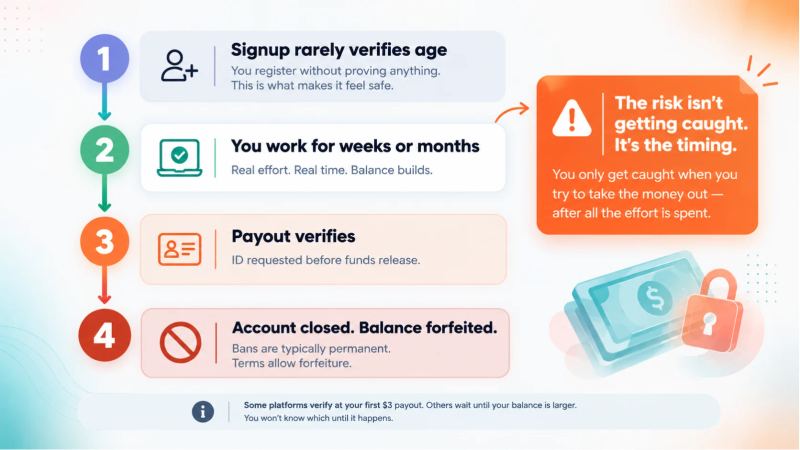
You lose the account, and you lose the money in it.
This is the part teenagers most often get wrong, and it's genuinely costly. Here's how it plays out:
- Sign-up rarely verifies age. You can usually register without proving anything. This is what makes it feel safe.
- Payout does verify. Platforms commonly request ID before releasing funds, especially on larger balances. This is an anti-fraud measure, not a personal attack.
- The mismatch surfaces. Your stated age and your ID don't match.
- The account is closed, and the balance is forfeited. Bans in this industry are typically permanent, and the terms of service almost always allow the platform to keep the balance.
The math is brutal. You'd be doing real work for weeks or months, then losing all of it at the exact moment you tried to collect.
It's worth saying plainly: the risk isn't getting caught. It's the timing. You only get caught when you try to take the money out — after all the effort is spent.
One more thing that catches people out: some platforms verify at the point of first payout, which for a $3 Swagbucks gift card could be day three. Others wait until you're a regular user with a larger balance. You won't know which you've joined until it happens.
Taxes: what teenagers need to know
Payout thresholds are not tax thresholds. These are two completely separate systems, and confusing them is a common and expensive mistake.
Three numbers worth knowing:
- $2,000 per platform per year is roughly where a US platform typically issues a 1099-NEC form. Reaching it doesn't change whether you owe tax — it just means the platform reports it.
- The dependent standard deduction for tax year 2026 is the greater of 450, capped at the standard deduction for single filers.
- The 2026 single-filer standard deduction is $16,100.
What this means practically: most teenagers earning from surveys won't owe federal income tax, because their earnings fall below the filing threshold. But there's a catch worth understanding.
Self-employment income — which is what task-platform work is — can trigger different rules. And a parent claiming you as a dependent needs to know about the income, because it can affect their return.
The habit that saves trouble later: track gross earnings per platform from day one. A simple spreadsheet with four columns — date, platform, amount, payout method — takes seconds per entry and makes tax season trivial. Starting that habit at 15 is genuinely easier than starting it at 25.
Frequently asked questions
How old do you have to be to take surveys?
Thirteen; on six platforms we track — Swagbucks, Harris Poll Online, SurveySavvy, dscout, CrowdTap, and Focus Forward. Another 13 platforms accept members between 14 and 16. Beyond surveys, every other category requires you to be 18.
What is the minimum age for survey sites?
Most survey sites set 16 or 18. The large majority of platforms that publish an age floor require 18, and only a small group accept anyone younger. The practical floor for a teenager is 13, but the options at that age are limited to survey panels.
Are there paid surveys for teens that actually pay?
Yes. Swagbucks pays gift cards from $3 and accepts members from 13 - the lowest cash - out threshold we've found anywhere. dscout accepts from 13 and pays $10 to $150 per mission. Expect survey earnings of roughly 2 to $6 an hour after screen-outs.
Can 13-year-olds make money online?
Yes, but only through survey panels, and only a small group of those accept that age. US law effectively rules out anything below 13: COPPA requires verifiable parental consent for under-13s, and the compliance cost makes it uneconomic for platforms.
Do you need parental consent to take surveys under 18?
For platforms operating under COPPA — which covers anything directed at under-13s in the US — yes, and it must be verifiable consent, not just permission. Many other platforms require a parent or guardian to co-sign the account. Treat its absence as a red flag.
What happens if you lie about your age on a survey site?
You lose the account and the balance. Platforms typically verify age at payout rather than signup, so the mismatch surfaces only when you try to withdraw. Bans are usually permanent, and terms of service generally allow the platform to keep forfeited earnings.
Why do most platforms require you to be 18?
Contracts, payouts, and tax paperwork. Most paid online work runs on agreements that minors can void, and payment systems are built around adult identity and tax reporting. The law sets the floor at 13; the industry sets its own at 18.
Do teenagers have to pay tax on online earnings?
Usually not on federal income tax, because earnings from surveys typically fall below the filing threshold. The standard deduction for 2026 is the greater of $1,350 or earned income plus $450. But self-employment rules can differ, and a parent claiming you as a dependent needs to know about the income.