
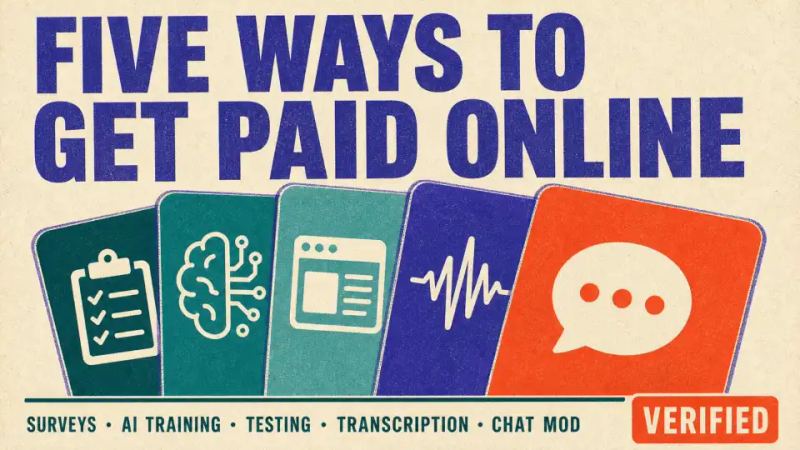
Paid online tasks are small, defined pieces of digital work, such as answering a survey, labeling an image, testing a website, transcribing audio, or moderating a chat, that a platform pays you for individually. Real rates run from about $0.50 per task to $125 per hour. Here's how each category actually pays.
What are paid online tasks?
Paid online tasks are individual units of work you complete for a platform, which pays you per unit rather than per hour or per month. You're not an employee. You're not even really a freelancer. You're closer to a supplier. You deliver a small thing, you get paid for it, and the relationship ends there.
That's the whole model. It sounds unglamorous because it is.
But here's what most people won't tell you: that structure is exactly why it works. Most require no interviews, résumé, or a boss. You can start tonight and stop whenever you like.
The trade-off is equally honest. Nobody is going to train you, promote you, or care whether you come back tomorrow. You're getting paid for output, not for showing up.
How paid online tasks differ from freelancing and gig apps
Three models get lumped together online. They're not the same thing, and confusing them is why so many people give up.
| Model | What you sell | Who sets the price | Typical pay |
|---|---|---|---|
| Paid task platforms | Small, defined units of work | The platform | $0.50–$40/hr |
| Freelancing | Your skill, scoped per project | You negotiate | $10–$150/hr |
| Gig apps (delivery, rideshare) | Your time and your vehicle | The algorithm | $12–$25/hr |
The five categories at a glance
Most online tasks fall into one of five buckets. Here's the map:
- Surveys & market research — share your opinion on products, ads, and ideas. The lowest barrier in the industry.
- AI training & data labeling — label images, grade AI answers, write example responses. The fastest-growing category, and the best-paying at the top end.
- Websites, games & app testing — use a site or app while talking out loud, then get paid per test.
- Transcription & captioning — turn audio into text. Paid per audio minute, which is not the same as per hour.
- Online chat & moderation — message support, moderate communities. Smallest category, and some of it is adult-adjacent.
We track all five. One in five US adults did some form of gig work last month, according to the Federal Reserve, and 70% of them spent under five hours a week on it.
The five kinds of paid online work, compared.
Here's the full comparison. Read the "best for" column carefully — that's where most people get it wrong.
| Category | Entry barrier | Typical pay | Best for | PayPal |
|---|---|---|---|---|
| Surveys & market research | Very low — sign up in minutes | $0.50–$3 per survey | Phone-only, fragmented time | Widely available |
| AI training & data labeling | Low to expert | Cents per microtask → $15–$100/hr | Strong written English, or a degree | Widely available |
| Websites, games & app testing | Low — pass a practice test | ~$10 per 20-minute test | A computer and a microphone | Yes |
| Transcription & captioning | Medium — pass a test | $0.30–$1.10 per audio minute | Fast, accurate typists | Yes, weekly cycles |
| Online chat & moderation | Medium | Varies widely | Comfort with high-volume messaging | Some |
1. Surveys & market research are the front door for most people. It's also a serious industry. Market research services are worth about $96.8 billion a year, and online surveys now account for more than 90% of quantitative studies worldwide. That's why the work exists. The catch is arithmetic: individual surveys pay $0.50 to $3, and screen-outs are constant. For example, Swagbucks pays out gift cards from just $3.
2. AI training & data labeling is where the money actually is. Some platforms run a distinct expert tier paying $100 or more an hour, and the market behind them is growing fast. Data annotation is projected to reach $38 billion by 2035. The floor is low, though: Clickworker takes beginners at cents per task. Outlier pays $15–$40 an hour and runs weekly payouts.
3. Websites, games & app testing is the best-paying entry-level work in the directory. UserTesting pays $10 for a test that takes about 20 minutes. That's a nominal $30 an hour, and you don't need a single day of experience. You do need to pass a practice test, and you need a working microphone.
4. Transcription & captioning deserve their own warning label. Advertised rates run from about $0.30 to $1.10 per audio minute depending on the platform. A one-hour file takes three to four hours of real work. The math can be worse than it looks. GoTranscript is the standard entry point, and it keeps applications mostly open.
5. Online chat & moderation is the most mixed. Some roles are ordinary support work. Others are adult-adjacent, which is why we flag those listings explicitly rather than quietly listing them.
How much do paid online tasks actually pay?
The honest answer: most people earn between $50 and $1000 a month for a few hours a week. The best-paying entry-level work — app and website testing — reaches roughly $10 for 20 minutes. The worst — surveys after screen-outs — can work out below $2 an hour.
Why the pay model matters more than the advertised rate
Here's the insight that changes how you read every platform's marketing: the pay model tells you how your earnings are shaped better than the headline rate does.
Points, per-task, hourly, per-study — one of a handful of pay models runs behind almost every platform. Four of them cover the vast majority:
- Per task. You get a fixed amount per completed unit. Predictable, and it rewards speed. Clickworker works this way.
- Points. You earn points that convert at a set rate. Flexible, but the conversion rate is where platforms get creative. Branded Surveys runs 100 points to $1.
- Per study or per mission. Larger chunks for longer commitments. dscout missions run $10 to $150.
- Hourly. The rarest, and usually the fairest. Prolific enforces a minimum of $8 an hour and recommends researchers pay at least $12.
Prolific is one of the major platforms we track that refuses to let researchers underpay participants. Their floor is £6/$8 per hour, enforced. Their recommendation is £9/$12. When one platform has to build a rule to stop the race to the bottom, that tells you something about the industry.
Academics have measured the bottom of that race. A study of 2,676 Amazon Mechanical Turk workers found a median hourly wage of roughly $2 — and only 4% earned more than the US federal minimum wage. That's not a bad week. That's the structural reality of unskilled microtask work.
So when you see "earn up to $50 an hour" on a task platform, ask one question: up to what, and for whom?
Realistic weekly earnings, by category
Here's what a few focused hours a week actually returns, based on verified rates:
| Category | Time per week (hours) | Realistic monthly earnings |
|---|---|---|
| Surveys & market research | 10–40 | $45–$515 |
| AI training (generalist) | 10–40 | $645–$6,880 |
| AI training (expert tier) | 10–40 | $1,505–$21,500 |
| App & website testing | 10–40 | $430–$3,440 |
| Transcription | 10–40 | $215–$3,095 |
| Chat & moderation | 10–40 | $345–$3,440 |
Read the expert-tier row again. A nurse practitioner, a teacher, or a software engineer can clear more in a day than a survey-taker clears in a month. Same industry. Different door.
That's the single most useful thing you can take from this article. The category you choose is the decision. Everything after it is optimization.
How paid online task platforms pay you
Most pay through PayPal. The rest split across gift cards, bank transfer, prepaid cards, and cryptocurrency.
Four things to check before you sign up anywhere:
- The payout method. PayPal is the safest default: fast, reversible, and accepted almost everywhere. Some platforms offer six methods. Clickworker is unusually flexible, covering SEPA and AirTM alongside the usual options.
- The minimum threshold. This is where money quietly goes missing. Gift-card minimums start as low as $3 at Swagbucks, but $5 and $10 are more common. A high threshold on a slow platform is a trap.
- The payout cadence. Some pay after each task. Some batch weekly. Some bimonthly. Some make you wait until the end of the month.
- The fee structure. A withdrawal fee that eats 5% of your earnings is a pay cut you agreed to without noticing.
One more thing worth knowing: many platforms pay more in your first few weeks. It's an onboarding boost, and it's deliberate. They want the habit to form before the rates normalize. Enjoy it, but don't build a budget on it.
Are paid online tasks legit?
Yes — the legitimate ones are completely real, and millions of people use them. But the fake version of this industry is large, well-funded, and specifically designed to look like the real thing. You need to know the difference before your first signup, not after.
The numbers are grim. Reported losses to job scams more than tripled between 2020 and 2023, topping $220 million in the first half of 2024 alone. Task scams, the specific fake version of what we're talking about here, went from about 5,000 reports in all of 2023 to roughly 20,000 in the first half of 2024.
By mid-2024, nearly 39% of all job-scam reports were task scams. In 2021, that figure was 0.6%.
Here's how the fake version works, straight from the FTC's own analysis:
- You get an unexpected message via WhatsApp, email, Telegram, text, or social media offering easy online work.
- You're told you'll do "product boosting" or "app optimization" tasks for a commission per click.
- Your earnings counter climbs steadily in the app. It's fake, but it looks real.
- You get paid a little, usually $5 to $20, to build trust.
- Then you're told to deposit your own money, almost always in crypto, to "unlock" your earnings.
- You deposit. The money is gone.
Tasks are often assigned in sets of 40, with a promised "level up" at the end. Some scammers even put you in a group chat where "experienced workers" share success stories. Those workers are fake too.
The three rules that catch nearly every scam:
- Real platforms never charge you to join. No registration fee. No "training" fee. No deposit. Ever.
- Real platforms never guarantee income. They can't. Task volume depends on demand, and demand fluctuates.
- Real platforms never recruit you by DM. They don't need to. They have a signup page.
If a platform fails any of those three, you don't need to research further. Close the tab.
>> To identify scam paid task platforms, run them through our scam-checker.
How to start earning with paid online tasks
The gap between people who earn from online task work and people who don't isn't effort. It's sequence. Here's the order that works.
Step 1 — Pick your category, not your platform. Match the category to what you already own. Only a phone and broken-up time? Surveys. A computer and a microphone? App testing. Fluent written English? Transcription or AI training. A degree or a professional license? Go straight to expert-tier AI work and skip the microtask grind entirely.
Step 2 — Join one platform. Not five. This is where most people go wrong. Signing up for 20 platforms feels productive and produces nothing. One platform, learned properly, beats eight half-used accounts.
Step 3 — Clear the entry gate. Most decent platforms have one: a practice test, a profile questionnaire, or an ID check. Do it the same day you sign up. Applications that sit unfinished for a week tend to stay unfinished.
Step 4 — Do the work, badly at first. Your first few submissions will be slow. That's normal, and it's fine. Speed comes from repetition, and most platforms have a quality threshold rather than a speed threshold.
Step 5 — Check your actual hourly rate. Divide what you earned by the time you spent, including the onboarding. This number is the only honest measure. If it's above $8, keep going. If it's below $3, change category — not platform.
Step 6 — Add a second platform, but only if the first is paying. Same category. Different platform. You're diversifying income, not attention.
One thing to skip entirely: don't chase every new platform you see advertised. The category decision drives 80% of your outcome. Platform-hopping drives almost none of it.
Which paid online task site should you start with?
There's no single best platform, because "best" depends entirely on what you have. Here's the honest routing:
| Your situation | Start here | Why |
|---|---|---|
| Phone only, 15-minute gaps | Swagbucks | Lowest cash-out we track — gift cards from $3 |
| Computer + microphone, no experience | UserTesting | $10 per 20-minute test, and the practice test is free |
| Fluent written English, want the highest ceiling | Micro1 | $15–$40/hr with weekly payouts |
| A degree or professional license | Expert-tier AI platforms | $35–$125/hr for credentialed domain work |
| Fast typist, patient with detail | GoTranscript | Applications always open — start the week you apply |
| Want guaranteed fair pay per hour | Prolific | Enforces an $8/hr minimum on researchers |
Notice what that table doesn't say. It doesn't say "the best platform is X." It says the best platform is the one that matches what you already have — and that's a much more useful question.
Frequently asked questions
What are paid online tasks?
Paid online tasks are small, defined units of digital work — surveys, data labeling, website testing, transcription, chat moderation — that platforms pay you for individually. You're paid per completed unit rather than per hour, and you choose when and how much you work.
Are paid online tasks legit?
Yes, the verified ones are. The platforms in our directory pay real money, and PayPal is the standard payout method. The scam version is also real and growing fast — task scams went from about 5,000 reports in 2023 to roughly 20,000 in just the first half of 2024. The test: if a platform charges you to join, guarantees income, or recruits you by DM, it's a scam.
How much can you realistically make doing paid online tasks?
Most people earn $100 to thousands a month working a few hours a week. Surveys pay the least — often under $2 an hour after screen-outs. App and website testing pays about $10 per 20-minute test. Expert-tier AI training is the outlier, reaching $35 to $125 an hour for credentialed specialists.
How do paid online task platforms pay you?
Most use PayPal, with the rest using gift cards, bank transfer, prepaid cards, or cryptocurrency. Minimum payout thresholds start as low as $3 for gift cards and are more commonly $5 to $10.
What is the best paid online task site for beginners?
It depends on what you own. With only a phone, Swagbucks has the lowest cash-out threshold we've found. With a computer and microphone, UserTesting pays $10 for a 20-minute test and needs no experience. With strong written English, Outlier pays $15 to $40 an hour.
Do you need experience to do paid online tasks?
For most categories, no. The vast majority of platforms in our directory require no experience at all. The exceptions are expert-tier AI training roles, which want a degree or professional credential, and transcription, which requires passing an accuracy test.
How many paid task sites should I join?
One to start, then two or three once the first is paying reliably. Signing up for eight platforms at once feels productive but produces almost nothing — the category you choose matters far more than how many platforms you're on.
Which paid online task sites pay via PayPal?
Most platforms in our directory pay via PayPal, including major survey panels, AI training platforms, and testing sites. PayPal is the safest default because it's fast, widely accepted, and lets you reverse a payment if something goes wrong.